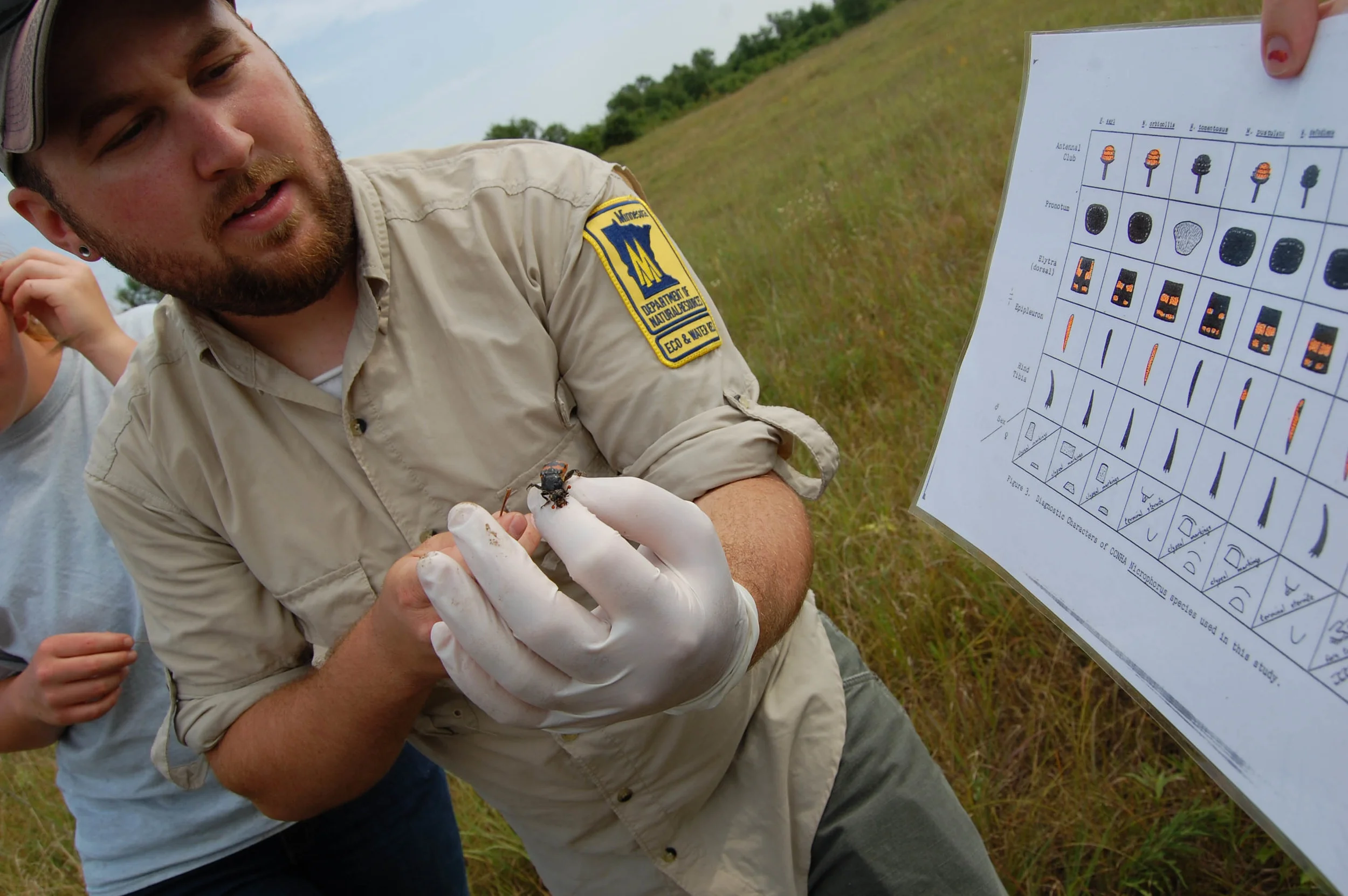
An Illustrated Key to the Burying Beetles (Nicrophorus spp.) of Minnesota
/Learn to identify Minnesota burying beetle (Nicrophorus) species with this illustrated two-page key.
Read MoreBlogging about field adventures, interesting species, and wildlife ecology and conservation.
Blog post by Christopher E. Smith (FieldEcology.com). Subscribe via e-mail, RSS, or follow on Twitter.
Learn to identify Minnesota burying beetle (Nicrophorus) species with this illustrated two-page key.
Read MoreA short hike off a road in the Sherburne National Wildlife Refuge, near Zimmerman, he drops to his knees next to a hole in the ground that’s been covered with chicken wire, plywood, and a concrete weight. As he removes the makeshift cover, a sickeningly sweet stench wafts out. Smith, a nongame wildlife biologist with the Minnesota Department of Natural Resources, wrinkles his nose as he reaches into a buried five-gallon plastic bucket and pulls out the deflated carcasses of two very dead, very rotten rats.
Read MoreIn temperate climates, many amphibians and reptiles hibernate during the cold winter months. Here in Minnesota, my current state of residence, it gets cold (mean winter temperate = 14° F / -10° C, record low = - 60° F / -51° C) - brrr. Yet, Minnesota is home 11 species of turtle (one of which is the invasive Red-eared Slider). This leaves turtles with roughly 5 - 7 months of good weather to breed, lay eggs, and feed to build up fat reserves.
Did you know? Minnesota is home to dozens of ladybird beetles, commonly referred to as "Ladybugs." Ladybugs are not true "bugs" (i.e., not in the order Hemiptera). Ladybugs are actually beetles (Order: Coleoptera), and are in the family Coccinellidae. Unfortunately some of our native ladybugs appear to be declining, and a few are on the verge of being lost completely in Minnesota. The most commonly observed ladybug for most, is the invasive Asian Ladybug (Harmonia axyridis) which is commonly observed entering homes and other buildings in the fall to overwinter. Asian ladybugs have become a pest in Minnesota.